
When we rebuilt the Chabri Energy website earlier this year, we drafted a comparison table laying out KuniSMART against charcoal, firewood, and LPG across the dimensions that institutional and household buyers actually weigh.
The table did not survive the final design. So we cut it. But the comparison itself was useful.
This guide compares Tanzania's four most common cooking fuels, charcoal, firewood, LPG, and KuniSMART briquettes, across cost, efficiency, smoke, environmental impact, supply security, and legal suitability for households and institutions.
What this is not
This is not a marketing comparison. The point of this article is not to demonstrate that KuniSMART wins every dimension. It does not, and pretending otherwise would insult the intelligence of the procurement officers, school administrators, and household buyers who actually make these decisions.
What this is, instead, is an honest accounting of the tradeoffs across the four cooking fuels Tanzanian buyers are actually choosing between. Where KuniSMART is the clearly better choice, we say so. Where another fuel makes more sense for a specific use case, we say that too.
Source
The fuel that produces the energy. Charcoal is produced from trees that have been cut and burned in low-oxygen conditions to create the carbonized product sold across the country. Firewood is wood cut directly for cooking, typically from local sources. LPG is imported liquefied petroleum gas, refined from petroleum extracted in countries with significant oil and gas reserves.
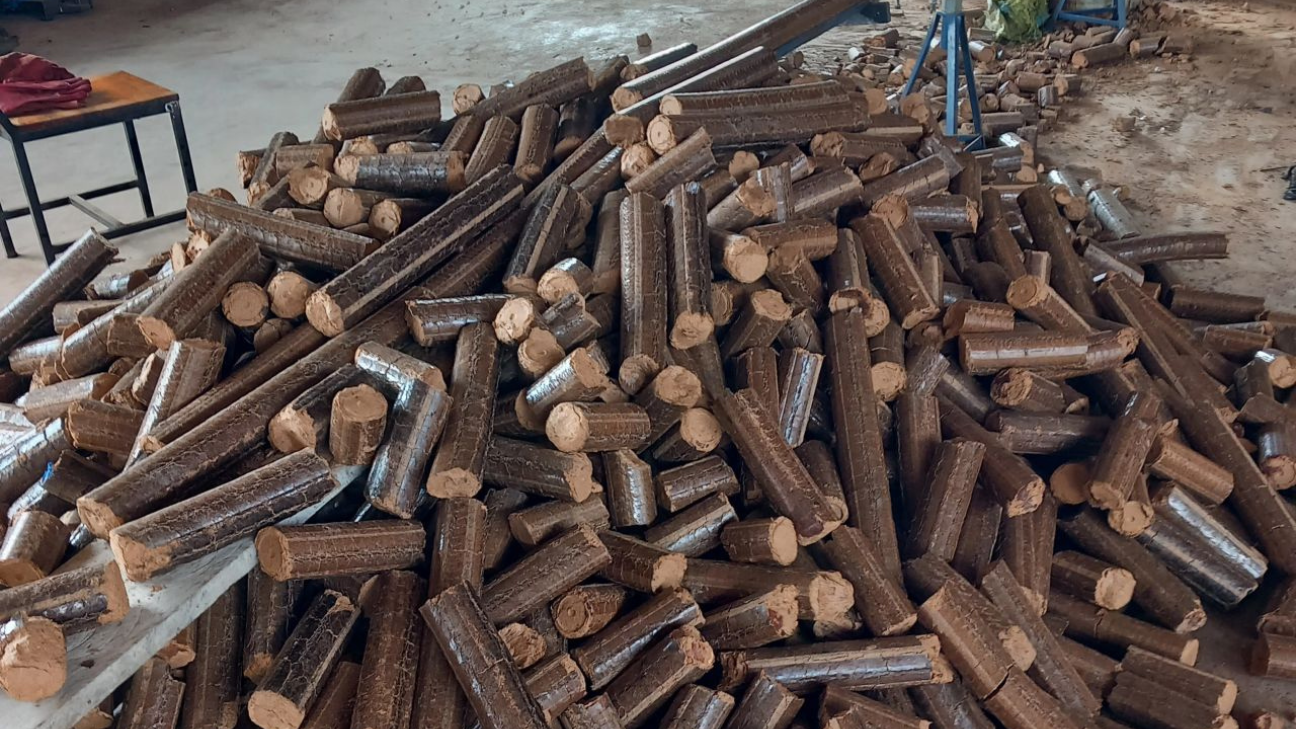
KuniSMART briquettes are manufactured from sawdust, timber offcuts, and agricultural waste — material that already exists in the local economy and would otherwise be burned in the open or sent to landfill.
The implication: every cooking decision is also a sourcing decision. Buyers choosing charcoal are choosing to contribute to ongoing deforestation. Buyers choosing LPG are choosing to depend on imports priced in a currency they do not control. Buyers choosing KuniSMART are choosing a circular use of local waste.
Burn efficiency
The amount of usable cooking energy produced per kilogram of fuel. Charcoal is the baseline against which most kitchens compare alternatives. Firewood is less efficient than charcoal — more fuel is required to cook the same meal. LPG is the most efficient per kilogram by a significant margin. KuniSMART burns approximately 30 percent more efficiently than charcoal.
The implication: efficiency matters more in long-running commercial and institutional cooking than in occasional household cooking. A school feeding 400 students daily will notice a 30 percent efficiency improvement directly in monthly fuel spend. A household cooking lunch will notice it less acutely. The fuel decision should account for cooking volume, not just per-kilogram performance.
Smoke and indoor air quality
The health implications of cooking with the fuel in an enclosed kitchen. Firewood produces the most smoke. Charcoal produces less than firewood but still releases significant particulates and carbon monoxide. LPG produces minimal smoke.
KuniSMART produces minimal smoke when burned in gasifier stoves, and significantly less smoke than charcoal even in traditional jikos.
The implication: this matters most for the people doing the daily cooking, who are disproportionately women and who spend hours daily in cooking spaces. The health cost of fuel choice is borne unequally. Any honest analysis of fuel decisions has to account for this.
Cost
The price the buyer actually pays. Charcoal varies but typically sits between TSH 1,000 and 2,000 per kilogram depending on the market. Firewood is often free if collected, costly if bought commercially. LPG is priced at the cylinder level — TSH 28,000 for 6kg, TSH 145,000 for 38kg at recent prices. KuniSMART is priced at TSH 500 per kilogram retail, with wholesale rates between TSH 500,000 and 800,000 per ton.
The implication: per kilogram, KuniSMART is cheaper than charcoal. Per cooking session, the savings compound because KuniSMART burns more efficiently than charcoal. Against LPG, KuniSMART has a structural cost advantage that does not depend on global oil prices or currency movements.
Supply security
How reliable the fuel supply is over time. Charcoal supply is informal, decentralized, and fluctuates seasonally. Firewood supply depends on local conditions and becomes scarcer in many areas as deforestation continues. LPG supply depends on imports, which depend on global supply chains, which depend on geopolitical and currency conditions outside the country. KuniSMART supply is local, regularized, and controlled by domestic production capacity.
The implication: for institutional buyers entering multi-year supply commitments, this dimension matters more than it appears. A fuel that is cheap today but supply-fragile tomorrow is not actually a viable institutional choice. KuniSMART's local production and stable pricing is the dimension that institutional buyers most often underweight in initial evaluations.
Institutional use
Whether the fuel can be legally used in institutions cooking for more than 100 people. The Government of Tanzania has prohibited charcoal and firewood as cooking fuel in such institutions. LPG is permitted. KuniSMART is permitted.
The implication: for schools, prisons, hospitals, and large institutional kitchens, the choice has narrowed to compliant alternatives. KuniSMART is among them, and at a significantly lower cost than the LPG alternatives most institutions are being pushed toward.
Environmental cost
The broader ecological implications of the fuel choice. Charcoal contributes to deforestation and soil degradation. Firewood contributes to deforestation directly. LPG has a carbon-intensive supply chain from extraction through refinement to import. KuniSMART uses existing waste material, requires no tree cutting, and has a circular supply chain.
The implication: this dimension matters most for institutional buyers whose decisions are evaluated against environmental criteria — schools with environmental education mandates, organizations with sustainability commitments, funders with ESG requirements. KuniSMART is the only fuel in this comparison that does not impose an environmental cost.
What this means in practice
The honest reading of the comparison above is this. No single fuel is the right answer for every kitchen. LPG is the right answer for urban middle-income households and institutions with the infrastructure and budget to handle it.
Firewood is the right answer for kitchens with abundant local biomass and no alternative, though the health cost is real. Charcoal is the right answer for nothing — it imposes environmental, health, and increasingly regulatory costs that the savings cannot offset.
KuniSMART is the right answer for households on daily cash flow that want to cook cleanly without changing how they cook. For food businesses where fuel cost directly affects daily margin. For institutions that need compliance with the national cooking ban without absorbing the price of imported alternatives. For partners and programmes deploying clean cooking at scale across regions where LPG infrastructure does not yet reach.
For most of Tanzania's kitchens — most of the time, in most of the contexts — KuniSMART is the better choice. The comparison above is why.
0 Comments